LANDSCAPES OF THE MIND
Bibliography
Books, papers, essays, and primary texts
Baars, Bernard — A Cognitive Theory of Consciousness (Cambridge University Press, 1988). [Global Workspace theory; named in the "theories of mind" list.]
Ball, Philip — The Book of Minds: How to Understand Ourselves and Other Beings, from Animals to AI to Aliens (Bodley Head / University of Chicago Press, 2022).
Bashō, Matsuo — Oku no Hosomichi (奥の細道 / The Narrow Road to the Deep North / Narrow Road to the Interior), 1689–1694. Standard English edition: trans. Nobuyuki Yuasa (Penguin Classics, 1966); also trans. Sam Hamill (Shambhala, 1998). Japanese original at Aozora Bunko: https://www.aozora.gr.jp/cards/000119/card749.html
Behrens, Timothy E. J., Timothy H. Muller, James C. R. Whittington, Shirley Mark, Alon B. Baram, Kimberly L. Stachenfeld & Zeb Kurth-Nelson — "What Is a Cognitive Map? Organizing Knowledge for Flexible Behavior," Neuron 100(2), 2018, 490–509. https://doi.org/10.1016/j.neuron.2018.10.002
Bellmund, Jacob L. S., Peter Gärdenfors, Edvard I. Moser & Christian F. Doeller — "Navigating Cognition: Spatial Codes for Human Thinking," Science 362(6415), 2018, eaat6766. https://doi.org/10.1126/science.aat6766 · Author PDF: https://scispace.com/pdf/navigating-cognition-spatial-codes-for-human-thinking-4l9th9mgpc.pdf
Benjamin, Walter — The Arcades Project (Harvard University Press, 1999); One-Way Street (1928); "The Work of Art in the Age of Its Technological Reproducibility" (1935–39). [The flâneur, distraction as reception, the Schwelle/threshold.]
Bond, Michael — Wayfinding: The Science and Mystery of How Humans Navigate the World (Picador, 2020). Publisher record: https://us.macmillan.com/books/9780374538576/wayfinding
Brentano, Franz — Psychology from an Empirical Standpoint (1874). [Intentionality as the mark of the mental.] German original at archive.org: https://archive.org/details/psychologievomem01bren
Bridle, James — Ways of Being: Animals, Plants, Machines — The Search for a Planetary Intelligence (Allen Lane / FSG, 2022). Author page: https://jamesbridle.com/books/ways-of-being
Burckhardt, Lucius — "Design Is Invisible" (1980).
Burckhardt, Lucius — "Strollological Observations on Perception of the Environment and the Tasks Facing Our Generation" (1996), trans. Jill Denton, in Lucius Burckhardt: Writings — Rethinking Man-made Environments (Springer, 2012); reprinted in Why Is Landscape Beautiful? The Science of Strollology (Birkhäuser, 2015). Full English PDF: https://monoskop.org/images/3/36/Burckhardt_Lucius_1996_2012_Strollological_Observations_on_Perception_of_the_Environment_and_the_Tasks_Facing_Our_Generation.pdf
Burckhardt, Lucius — Why Is Landscape Beautiful? The Science of Strollology, ed. Markus Ritter & Martin Schmitz (Birkhäuser, 2015). https://www.degruyterbrill.com/document/doi/10.1515/9783038210566/html
Burckhardt, Lucius — The Minimal Intervention (Eng. ed. 2024, Martin Schmitz Verlag).
Buzsáki, György — Rhythms of the Brain (Oxford University Press, 2006). [Cited in Handout Three for replay hardening walked paths into memory.] https://doi.org/10.1093/acprof:oso/9780195301069.001.0001
Certeau, Michel de — The Practice of Everyday Life (1980; trans. Steven Rendall, University of California Press, 1984), esp. ch. VII "Walking in the City." ["Space is a practiced place," p. 117.]
Chatwin, Bruce — The Songlines (Jonathan Cape, 1987).
Churchland, Paul M. — "Eliminative Materialism and the Propositional Attitudes," Journal of Philosophy 78(2), 1981, 67–90. https://doi.org/10.2307/2025900 [With Patricia Churchland; named in the "theories of mind" list.]
Clark, Andy — Surfing Uncertainty: Prediction, Action, and the Embodied Mind (Oxford University Press, 2016). https://doi.org/10.1093/acprof:oso/9780190217013.001.0001
Clark, Andy & David Chalmers — "The Extended Mind," Analysis 58(1), 1998, 7–19. https://doi.org/10.1093/analys/58.1.7 · Free text: https://consc.net/papers/extended.html
Constantinescu, Alexandra O., Jill X. O'Reilly & Timothy E. J. Behrens — "Organizing Conceptual Knowledge in Humans with a Gridlike Code," Science 352(6292), 2016, 1464–1468. https://doi.org/10.1126/science.aaf0941
Crawford, Matthew B. — The World Beyond Your Head: On Becoming an Individual in an Age of Distraction (Farrar, Straus and Giroux, 2015).
Dante Alighieri — Inferno, Canto I (c. 1320), trans. Henry Wadsworth Longfellow (1867). Public domain: https://www.gutenberg.org/ebooks/1001
Debord, Guy — "Théorie de la dérive" / "Theory of the Dérive," Les Lèvres Nues 9 (1956); Internationale Situationniste 2 (1958). English text: https://www.cddc.vt.edu/sionline/si/theory.html [See also The Naked City map, 1957.]
Dehaene, Stanislas — Consciousness and the Brain (Viking, 2014). [Global workspace; named in the "theories of mind" list.]
Descartes, René — Meditations on First Philosophy (1641). Public domain: https://www.gutenberg.org/ebooks/59
Devlin, Christopher (ed.) — The Sermons and Devotional Writings of Gerard Manley Hopkins (Oxford University Press, 1959). [Commentary contesting Peters on inscape/haecceitas.]
Di Paolo, Ezequiel, Thomas Buhrmann & Xabier Barandiaran — Sensorimotor Life: An Enactive Proposal (Oxford University Press, 2017). [Enactivism; named in the "theories of mind" list.]
Dickinson, Emily — "The Brain—is wider than the Sky—" (c. 1862), Fr598 / J632. Public domain: https://www.gutenberg.org/ebooks/12242
Dillard, Annie — "Seeing," in Pilgrim at Tinker Creek (Harper's Magazine Press, 1974).
Dōgen, Eihei — "Sansuikyō" / "Mountains and Waters Sutra" (1240), from Shōbōgenzō. Common English version: trans. Kazuaki Tanahashi, in Moon in a Dewdrop (North Point Press, 1985). Sōtō Zen Text Project: https://www.thezensite.com/ZenTeachings/Dogen_Teachings/Mountains_and_Waters_Sutra.htm
Donnellan, Declan — The Actor and the Target (Nick Hern Books, 2002; rev. eds. 2005, 2019). Here is the first chapter.
Donnellan, Declan — The Actor and the Space (Nick Hern Books, 2024). https://www.nickhernbooks.co.uk/the-actor-and-the-space
Fiebelkorn, Ian C. & Sabine Kastner — "A Rhythmic Theory of Attention," Trends in Cognitive Sciences 23(2), 2019, 87–101. https://doi.org/10.1016/j.tics.2018.11.009
Fodor, Jerry — The Language of Thought (Harvard University Press, 1975). [Functionalism/computationalism.]
Friston, Karl — "The Free-Energy Principle: A Unified Brain Theory?," Nature Reviews Neuroscience 11, 2010, 127–138. https://doi.org/10.1038/nrn2787
Gardner, W. H. — Gerard Manley Hopkins (1844–1889): A Study of Poetic Idiosyncrasy in Relation to Poetic Tradition, 2 vols. (Secker & Warburg / Oxford University Press, 1944–49). [Source of the species specialissima reading of inscape.]
Gendlin, Eugene T. — Focusing (Everest House, 1978); Experiencing and the Creation of Meaning (Free Press, 1962). [Origin of "felt sense."] https://focusing.org/felt-sense/what-felt-sense
Gibson, James J. — The Ecological Approach to Visual Perception (Houghton Mifflin, 1979; Psychology Press classic ed. 2014), esp. ch. 8 "The Theory of Affordances."
Gibson, James J. — "The Theory of Affordances," in R. Shaw & J. Bransford (eds.), Perceiving, Acting, and Knowing (Lawrence Erlbaum, 1977), 67–82.
Gros, Frédéric — A Philosophy of Walking (2008; trans. John Howe, Verso, 2014).
Hafting, Torkel, Marianne Fyhn, Sturla Molden, May-Britt Moser & Edvard I. Moser — "Microstructure of a Spatial Map in the Entorhinal Cortex," Nature 436, 2005, 801–806. https://doi.org/10.1038/nature03721 [The grid-cell discovery.]
Harley, J. B. — "Deconstructing the Map," Cartographica 26(2), 1989, 1–20. https://doi.org/10.3138/E635-7827-1757-9H7V
Heidegger, Martin — Die Kategorien- und Bedeutungslehre des Duns Scotus (habilitation, 1915). [Heidegger link discussed via Llewelyn.]
Hiott, Andrea — Holding Paradox: The Navigational Approach to Mind.
Hiott, Andrea — Radical Embodied Relation at any Scale: From Remembering to Navigating
Hopkins, Gerard Manley — "As Kingfishers Catch Fire" (c. 1877). Public domain: https://www.poetryfoundation.org/poems/44389/as-kingfishers-catch-fire-dragonflies-draw-flame
Hopkins, Gerard Manley — The Journals and Papers of Gerard Manley Hopkins, ed. Humphry House & Graham Storey (Oxford University Press, 1959). [The 1868 Parmenides notes: first appearance of "inscape" and "instress."]
Illich, Ivan — Tools for Conviviality (Harper & Row, 1973). Full text: https://archive.org/details/toolsforconvivia00illi
Illich, Ivan — Energy and Equity (Calder & Boyars, 1974). Full text: https://archive.org/details/energyequity0000illi
Ingold, Tim — Lines: A Brief History (Routledge, 2007). https://doi.org/10.4324/9780203961155
Ingold, Tim — Being Alive: Essays on Movement, Knowledge and Description (Routledge, 2011), esp. "Against Space: Place, Movement, Knowledge" and "Footprints Through the Weather-World." https://doi.org/10.4324/9780203818336
James, William — The Principles of Psychology, 2 vols. (Henry Holt, 1890), esp. ch. IV "Habit" and ch. XI "Attention." Full text: https://psychclassics.yorku.ca/James/Principles/
Klee, Paul — Pedagogical Sketchbook (1925). ["A drawing is simply a line going for a walk" — as transmitted through Ingold.]
Kelly, Lynne — The Memory Code (Allen & Unwin, 2016; Pegasus, 2017).
kollektiv orangotango+ (eds.) — This Is Not an Atlas: A Global Collection of Counter-Cartographies (transcript Verlag, 2018). Open access, full PDF: https://notanatlas.org/book/ · https://doi.org/10.14361/9783839445198
Korzybski, Alfred — Science and Sanity (1933). ["The map is not the territory."]
Leroi-Gourhan, André — Le Geste et la parole, 2 vols. (Albin Michel, 1964–65) / Gesture and Speech, trans. Anna Bostock Berger (MIT Press, 1993). [Technique, gesture, and the chaîne opératoire; the walking, tool-using body as the ground of thought and memory — the deep prehistory behind Ingold's wayfaring.] https://en.wikipedia.org/wiki/Andr%C3%A9_Leroi-Gourhan
Llewelyn, John — Gerard Manley Hopkins and the Spell of John Duns Scotus (Edinburgh University Press, 2015). https://doi.org/10.3366/edinburgh/9781474400930.001.0001
Lu Xun — "Hometown" (故乡), in Call to Arms (呐喊, 1923). [Closing lines on hope and roads made by walking.]
Machado, Antonio — "Proverbios y cantares," XXIX, in Campos de Castilla (1912). Public domain; Biblioteca Virtual Miguel de Cervantes: https://www.cervantesvirtual.com/obra/campos-de-castilla--0/
Macfarlane, Robert — The Old Ways: A Journey on Foot (Hamish Hamilton, 2012).
Maguire, Eleanor A., David G. Gadian, Ingrid S. Johnsrude, Catriona D. Good, John Ashburner, Richard S. J. Frackowiak & Christopher D. Frith — "Navigation-Related Structural Change in the Hippocampi of Taxi Drivers," PNAS 97(8), 2000, 4398–4403. https://doi.org/10.1073/pnas.070039597
Massey, Doreen — For Space (SAGE, 2005).
McGilchrist, Iain — The Master and His Emissary: The Divided Brain and the Making of the Western World (Yale University Press, 2009).
McGilchrist, Iain — The Matter With Things (Perspectiva Press, 2021).
Merleau-Ponty, Maurice — Phénoménologie de la perception (1945) / Phenomenology of Perception, trans. Donald Landes (Routledge, 2012), esp. "The Spatiality of One's Own Body and Motility." https://doi.org/10.4324/9780203720714
The Body as Mediator (easier intro to Merleau-Ponty)
Morton, Timothy — The Ecological Thought (Harvard University Press, 2010).
Morton, Timothy — Hyperobjects: Philosophy and Ecology after the End of the World (University of Minnesota Press, 2013).
Murdoch, Iris — The Sovereignty of Good (Routledge & Kegan Paul, 1970).
Nagel, Thomas — "What Is It Like to Be a Bat?," The Philosophical Review 83(4), 1974, 435–450. https://doi.org/10.2307/2183914
Neale, Margo & Lynne Kelly — Songlines: The Power and Promise (First Knowledges series, Thames & Hudson Australia, 2020). https://thameshudson.com.au/product/songlines-the-power-and-promise/
Nobel Assembly at Karolinska Institutet — The Nobel Prize in Physiology or Medicine 2014: John O'Keefe, May-Britt Moser and Edvard I. Moser, "for their discoveries of cells that constitute a positioning system in the brain." Press release and scientific background ("an inner GPS"): https://www.nobelprize.org/prizes/medicine/2014/press-release/ · Advanced information: https://www.nobelprize.org/prizes/medicine/2014/advanced-information/
Noë, Alva — Action in Perception (MIT Press, 2004). [Enactivism.]
Odell, Jenny — How to Do Nothing: Resisting the Attention Economy (Melville House, 2019).
O'Keefe, John & Jonathan Dostrovsky — "The Hippocampus as a Spatial Map: Preliminary Evidence from Unit Activity in the Freely-Moving Rat," Brain Research 34(1), 1971, 171–175. https://doi.org/10.1016/0006-8993(71)90358-1 [The place-cell discovery.]
O'Keefe, John & Lynn Nadel — The Hippocampus as a Cognitive Map (Oxford University Press, 1978). Full text free (rights reverted to the authors): http://www.cognitivemap.net · https://repository.arizona.edu/handle/10150/620894
O'Keefe, John & Lynn Nadel — "Précis of The Hippocampus as a Cognitive Map," Behavioral and Brain Sciences 2(4), 1979, 487–494. https://doi.org/10.1017/S0140525X00063949
Oliver, Mary — Upstream: Selected Essays (Penguin Press, 2016). ["Attention is the beginning of devotion."]
Peluso, Nancy Lee — "Whose Woods Are These? Counter-Mapping Forest Territories in Kalimantan, Indonesia," Antipode 27(4), 1995, 383–406. https://doi.org/10.1111/j.1467-8330.1995.tb00286.x [Coins "counter-mapping."]
Perec, Georges — Tentative d'épuisement d'un lieu parisien (1975) / An Attempt at Exhausting a Place in Paris, trans. Marc Lowenthal (Wakefield Press, 2010).
Perl, Sondra — Felt Sense: Writing with the Body (Boynton/Cook Heinemann, 2004).
Peters, W. A. M. — Gerard Manley Hopkins: A Critical Essay Towards the Understanding of His Poetry (Oxford University Press, 1948; repr. 1970).
Place, U. T. — "Is Consciousness a Brain Process?," British Journal of Psychology 47(1), 1956, 44–50. https://doi.org/10.1111/j.2044-8295.1956.tb00560.x
Plato — Meno (c. 380 BCE), the learner's paradox (80d). Public domain, trans. Jowett: https://www.gutenberg.org/ebooks/1643
Putnam, Hilary — "The Nature of Mental States" (1967), in Mind, Language and Reality (Cambridge University Press, 1975). [Functionalism, multiple realizability.]
Randolph, Sal — "Ways of Seeing: Spectacle," The Boat (Substack). https://salrandolph.substack.com/p/ways-of-seeing-spectacle
Rutherglen, Michael — "Hopkins's Material Poetics: Sense and the Inscapes of Speech," Victorian Poetry 56(3), 2018, 249–268. https://doi.org/10.1353/vp.2018.0016
Ryle, Gilbert — The Concept of Mind (Hutchinson, 1949). ["The ghost in the machine."]
Sei Shōnagon — Makura no Sōshi / The Pillow Book (c. 1002). Standard English: trans. Meredith McKinney (Penguin Classics, 2006); older public-domain trans. Arthur Waley (1928): https://archive.org/details/pillowbookofseis00seis
Shepherd, Nan — The Living Mountain: A Celebration of the Cairngorm Mountains of Scotland (written 1940s; Aberdeen University Press, 1977; Canongate, 2011).
Skinner, B. F. — Science and Human Behavior (Macmillan, 1953). [Behaviourism.] Free PDF: https://www.bfskinner.org/newtestsite/wp-content/uploads/2014/02/ScienceHumanBehavior.pdf
Smart, J. J. C. — "Sensations and Brain Processes," The Philosophical Review 68(2), 1959, 141–156. https://doi.org/10.2307/2182164
Solnit, Rebecca — Wanderlust: A History of Walking (Viking, 2000). ["A path is a prior interpretation of the best way to traverse a landscape," p. 54.]
Solnit, Rebecca — A Field Guide to Getting Lost (Viking, 2005), esp. "Open Door" and "The Blue of Distance."
Tavares, Rita Morais, Avi Mendelsohn, Yael Grossman, Christian Hamilton Williams, Matthew Shapiro, Yaacov Trope & Daniela Schiller — "A Map for Social Navigation in the Human Brain," Neuron 87(1), 2015, 231–243. https://doi.org/10.1016/j.neuron.2015.06.011
Thompson, Evan — Mind in Life: Biology, Phenomenology, and the Sciences of Mind (Harvard University Press, 2007). [Enactivism.]
Thompson, Nato (ed.) — Experimental Geography: Radical Approaches to Landscape, Cartography, and Urbanism (Melville House / Independent Curators International, 2008). https://www.amazon.com/Experimental-Geography-Approaches-Landscape-Cartography/dp/0091636582 · Curatorial project: https://curatorsintl.org/exhibitions/experimental-geography
Thoreau, Henry David — Walden; or, Life in the Woods (1854), esp. "Conclusion." Public domain: https://www.gutenberg.org/ebooks/205
Thoreau, Henry David — "Walking" (The Atlantic, 1862). Public domain: https://www.gutenberg.org/ebooks/1022
Tolman, Edward C. — "Cognitive Maps in Rats and Men," Psychological Review 55(4), 1948, 189–208. https://doi.org/10.1037/h0061626 · Full text free: https://psychclassics.yorku.ca/Tolman/Maps/maps.htm
Tononi, Giulio — "An Information Integration Theory of Consciousness," BMC Neuroscience 5:42, 2004. https://doi.org/10.1186/1471-2202-5-42
Tsing, Anna Lowenhaupt — The Mushroom at the End of the World: On the Possibility of Life in Capitalist Ruins (Princeton University Press, 2015). https://doi.org/10.1515/9781400873548
Tversky, Barbara — Mind in Motion: How Action Shapes Thought (Basic Books, 2019). [The Nine Laws of Cognition; Law 6: "Spatial thinking is the foundation of abstract thought."] Review: https://undark.org/2019/06/28/mind-in-motion-review/
Uexküll, Jakob von — Streifzüge durch die Umwelten von Tieren und Menschen (1934) / A Foray into the Worlds of Animals and Humans, trans. Joseph D. O'Neil (University of Minnesota Press, 2010).
Varda, Agnès — Les Plages d'Agnès / The Beaches of Agnès (film, 2008). ["If we opened people up, we'd find landscapes."]
Varela, Francisco J., Evan Thompson & Eleanor Rosch — The Embodied Mind: Cognitive Science and Human Experience (MIT Press, 1991; rev. ed. 2016).
Weil, Simone — La Pesanteur et la Grâce (1947) / Gravity and Grace, trans. Emma Crawford & Mario von der Ruhr (Routledge, 2002).
Weil, Simone — "Reflections on the Right Use of School Studies with a View to the Love of God" (1942), in Waiting for God, trans. Emma Craufurd (Putnam, 1951). [Attention as prayer; see also the letter to Joë Bousquet for "the rarest and purest form of generosity" — verify attribution.]
Whitman, Walt — "There Was a Child Went Forth," in Leaves of Grass (1855). Public domain: https://www.gutenberg.org/ebooks/1322
Williams, James — Stand Out of Our Light: Freedom and Resistance in the Attention Economy (Cambridge University Press, 2018). Open access (CC BY-NC): https://www.cambridge.org/core/books/stand-out-of-our-light/3F8D7BA2C0FE3A7126A4D9B73A89415D · https://doi.org/10.1017/9781108453004
Williams, Raymond — Marxism and Literature (Oxford University Press, 1977). ["Structures of feeling" — the probable second "Williams" flagged in the Session Two draft; needs confirming.]
Wu, Tim — The Attention Merchants: The Epic Scramble to Get Inside Our Heads (Knopf, 2016).
Yarbus, Alfred L. — Eye Movements and Vision, trans. Basil Haigh (Plenum Press, 1967). [The scanpath studies; "The Unexpected Visitor."] https://doi.org/10.1007/978-1-4899-5379-7
Yates, Frances A. — The Art of Memory (Routledge & Kegan Paul, 1966).
Yunkaporta, Tyson — Sand Talk: How Indigenous Thinking Can Save the World (Text Publishing, 2019).
Zhuangzi — Zhuangzi, ch. 2 ("Qiwulun" / "The Adjustment of Controversies"), 4th c. BCE: 道行之而成 — "a road is made by walking it." Chinese text with Legge translation: https://ctext.org/zhuangzi/adjustment-of-controversies
Zuboff, Shoshana — The Age of Surveillance Capitalism (PublicAffairs, 2019).
Zwicky, Jan — Lyric Philosophy (University of Toronto Press, 1992; rev. ed. Brush Education, 2014).
Websites, media, and collective projects
Center for Humane Technology — https://www.humanetech.com [Tristan Harris, "the race to the bottom of the brain stem."]
Crossref-it.info — "Inscape and instress" (explainer on Hopkins). https://crossref-it.info/textguide/gerard-manley-hopkins-selected-poems/38/2554
Dayrit, Cian — embroidered counter-maps; Philippines chapter in This Is Not an Atlas. https://notanatlas.org
The Decolonial Atlas — https://decolonialatlas.wordpress.com
GerardManleyHopkins.org — "Studies / Philosophy" essay on Hopkins and Duns Scotus. https://www.gerardmanleyhopkins.org
Thompson, Nainoa — master navigator, Polynesian Voyaging Society; first Hawaiian in centuries to navigate long-distance by non-instrument wayfinding. https://en.wikipedia.org/wiki/Nainoa_Thompson
Hōkūleʻa / Polynesian Voyaging Society — non-instrument wayfinding. https://hokulea.com
Lang, Gerhard — Mobile Zebra Crossing (1993). [Strollological intervention, discussed with Burckhardt.]
McGilchrist, Iain — "The Divided Brain," RSA Animate (2011, ~11 min). https://www.thersa.org/animate
notanatlas.org — counter-cartography galleries and the open-access book. https://notanatlas.org
Intro Texts From Class and Miscellaneous
Intro to Affordances: https://ixdf.org/literature/book/the-encyclopedia-of-human-computer-interaction-2nd-ed/affordances#423_theoretical_roots-2
AFFORDANCE and Design by Don Norman: https://jnd.org/affordances-and-design/
Ch 8 of Ecological Approach to Visual Perception https://monoskop.org/images/c/c6/Gibson_James_J_1977_1979_The_Theory_of_Affordances.pdf
More clarification if you really want it
https://graphicsinterface.org/wp-content/uploads/gi2000-24.pdf
https://media.pluto.psy.uconn.edu/MC.pdf
An influential but maybe not so easy paper from some friends in Amsterdam about Landscape and Affordances
Hidden Brain episode about mental mapping (Thanks Amanda)
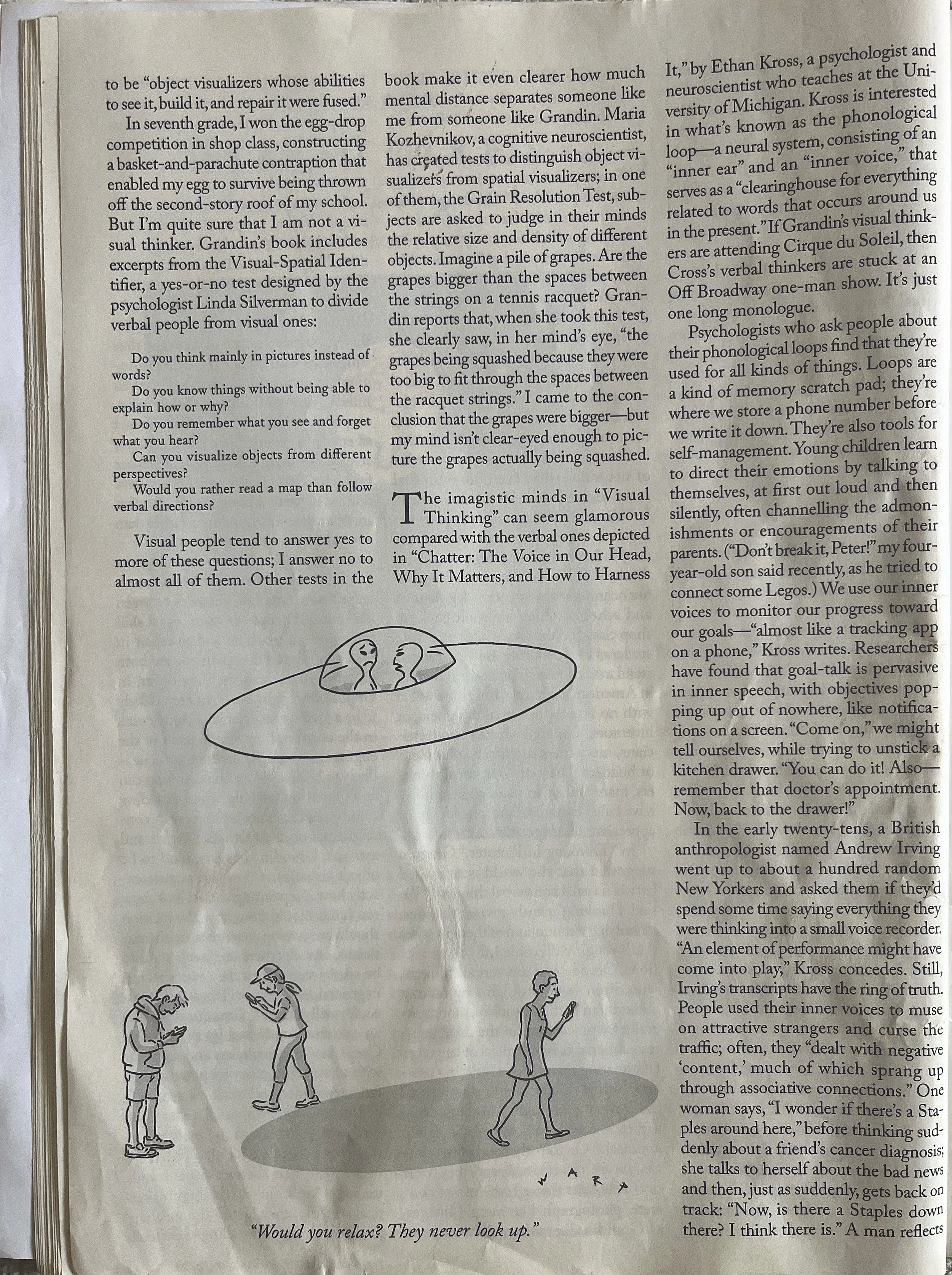
Thought Process by JR in New Yorker (what kind of thinker are you?)